Overseas Vietnamese Property Ownership: Land Law 2024 & Legal Capital Flows

- 1. Breakthrough Regulations of the 2024 Land Law on Property Ownership Rights for Overseas Vietnamese
- 2. Conditions & Legal Dossier for Overseas Vietnamese to Directly Hold a Pink Book
- 3. Detailed Legal Procedures for Purchasing a Home in the Homeland
- 4. Legal Capital Flows & Repatriation Mechanisms Upon Divestment
- 5. Price List & Featured High-End Projects Attracting Overseas Vietnamese 2025 – 2026
- 6. 4 Crucial Considerations for Overseas Vietnamese Property Investment to Avoid Legal Risks
- 7. Frequently Asked Questions (FAQ) for Overseas Vietnamese Buying Homes in Vietnam
The amended Land Law 2024, officially effective from August 1, 2024, marks a historic turning point for the community of over 6 million Vietnamese residing abroad. The complete removal of discriminatory barriers between “Vietnamese residing abroad” and “domestic individuals” in land use rights has opened the door for overseas Vietnamese to directly own legal, secure, and transparent real estate. This NALUX Development article provides a comprehensive legal handbook, updated market prices, and standardized remittance procedures for owning assets in the homeland.
1. Breakthrough Regulations of the 2024 Land Law on Property Ownership Rights for Overseas Vietnamese
The Land Law 2024 grants absolute equality to Vietnamese residing abroad (who retain Vietnamese nationality), allowing them to enjoy full land use rights, housing ownership rights, and asset transfer rights like any citizen living in the country.
1.1. Absolute Equality in Land and Housing Rights
Under the Land Law 2024, Vietnamese citizens residing abroad are categorized under the same group as “domestic individuals.” This means overseas Vietnamese are permitted to receive transfers of residential land use rights (purchase land plots), receive gifts, inheritances, and buy and sell all types of future or existing housing without limitations on the number of units or projects, unlike previous regulations.
1.2. Rights for Persons of Vietnamese Origin Residing Abroad
For persons of Vietnamese origin (who have renounced Vietnamese nationality or hold only foreign nationality), the Land Law 2024 and Housing Law 2023 still provide an expanded legal framework: those permitted to enter Vietnam have the right to own housing attached to residential land use rights within commercial housing development projects, and are granted a Certificate of Land Use Rights and Ownership of Houses and Other Land-Attached Assets (Pink Book) in their own name.
1.3. End to the Practice of “Entrusting Relatives to Hold Title”
Previously, due to complex proof-of-origin procedures, tens of thousands of overseas Vietnamese had to entrust relatives in Vietnam to hold title when purchasing property, leading to countless prolonged asset disputes, capital losses, and strained family relationships. The new law, with its transparent mechanism, enables overseas Vietnamese to confidently hold direct title, preserving their legal assets under the protection of Vietnamese law.
2. Conditions & Legal Dossier for Overseas Vietnamese to Directly Hold a Pink Book
The prerequisite for overseas Vietnamese to legally purchase property is proof of Vietnamese nationality (valid Vietnamese passport) or documentation certifying their Vietnamese origin, accompanied by a valid entry stamp into Vietnam from immigration authorities.
2.1. Group 1: Overseas Vietnamese Retaining Vietnamese Nationality
The legal documentation is highly streamlined, including:
- A valid Vietnamese passport.
- An entry stamp from Vietnamese immigration authorities on the passport (or on a separate visa card).
- Citizen ID card or personal identification number (if registered during previous visits to Vietnam).
This group has the right to buy, sell, gift, and inherit real estate with 100% equality to domestic residents.
2.2. Group 2: Persons of Vietnamese Origin Residing Abroad (Holding Only Foreign Passports)
This includes overseas Vietnamese who have acquired US, Australian, Canadian, French, German, etc., nationality but no longer hold a Vietnamese passport:
- A valid foreign passport with a legal entry stamp into Vietnam.
- Documents proving Vietnamese origin: A certificate of Vietnamese origin issued by a Vietnamese diplomatic mission abroad (Embassy/Consulate) or the State Committee for Overseas Vietnamese; or a copy of a birth certificate, old household registration book, or previous civil status extract.
2.3. Conditions for Transparent Capital Sources
The funds for property payment must be channeled through credit institutions authorized to operate in Vietnam, accompanied by a sales contract or transaction agreement to prove the legitimate purpose of the remittance in accordance with the Ordinance on Foreign Exchange.
3. Detailed Legal Procedures for Purchasing a Home in the Homeland
The real estate transaction process for overseas Vietnamese comprises 4 standard steps: (1) Legal due diligence of the project; (2) Opening a foreign currency/VND payment account at a Vietnamese commercial bank; (3) Notarizing the sales contract; and (4) Registering for direct Pink Book issuance.
3.1. Legal Remittance Channels to Vietnam
Transferring money from abroad to pay for a home purchase contract must be done through official channels to ensure the funds are recognized by the bank as legitimate, facilitating future transfers and repatriation of foreign currency to the country of residence:
| Remittance Channel | Key Advantages | Cost & Processing Time | Recommended Use |
|---|---|---|---|
| Bank Swift Transfer | Absolute security, Swift MT103 document clearly stating the purpose of property payment, 100% legal protection. | Average fee 0.15% – 0.25%, processed in 1 – 3 business days. | Optimal for high-value apartment purchases. |
| Bank-Affiliated Remittance Companies | Fast payout network, direct support for relatives or direct transfer to the developer’s escrow account. | Flexible exchange rates based on parent bank fees, funds received within 24 hours. | Suitable for installment payments according to project progress. |
| International Financial Services | Convenient for smaller amounts, fast online procedures. | Low limits, relatively high fees compared to large bank transfers. | Only recommended for initial booking deposits. |
3.2. Procedures for Registering a Pink Book in the Name of Overseas Vietnamese
After receiving the handover of the property, the application for a Certificate of Ownership is submitted to the Land Registration Office, including: Notarized sales contract, handover minutes, VAT payment invoices, copy of passport with entry stamp, and proof of overseas Vietnamese origin. The processing time for Pink Book issuance is 30 to 45 working days according to standard administrative regulations.

4. Legal Capital Flows & Repatriation Mechanisms Upon Divestment
According to the Ordinance on Foreign Exchange and State Bank Circulars, all principal and legitimate profits from selling or leasing real estate in Vietnam are permitted to be converted into foreign currency and transferred back to the country of residence after all tax obligations have been fulfilled.
This is a primary concern for the overseas Vietnamese community when investing hundreds of thousands to millions of USD in their homeland. To ensure smooth repatriation of funds, overseas Vietnamese should retain a complete set of documents:
- Initial transfer documents: Swift transfer slip or remittance confirmation clearly stating the purpose of property payment.
- Notarized real estate transfer contract: Clearly showing the actual transaction value.
- Personal income tax (PIT) payment receipt: When transferring real estate, the applicable PIT rate is 2% of the total transaction value.
- Confirmation letter from the servicing bank: The bank where the overseas Vietnamese holds their investment account will execute the foreign currency transfer order abroad automatically and legitimately.
5. Price List & Featured High-End Projects Attracting Overseas Vietnamese 2025 – 2026
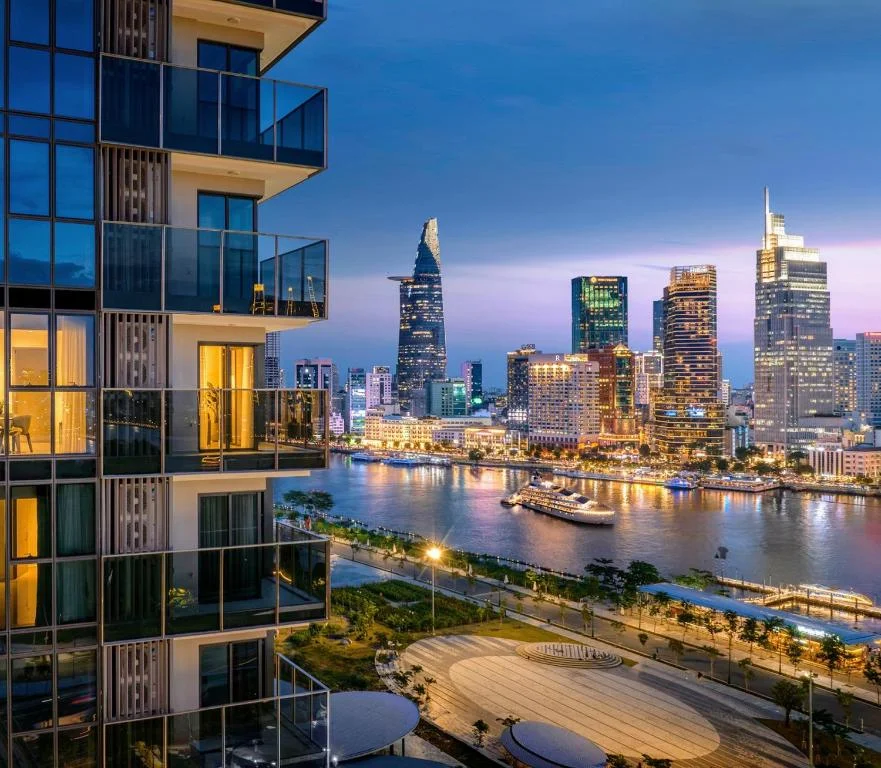
In the Ho Chi Minh City market, overseas Vietnamese prioritize projects meeting 3 core standards: international management guaranteeing rental value, complete legal transparency, and a riverside or Metro Line 1-adjacent location, with prices typically ranging from 105 – 650 million VND/m2 ($4,200 – $25,000/m2).
Summary Table of Projects Most Suitable for Overseas Vietnamese Residents & Investors (Updated 2025 – 2026)
| Project Name | Developer | Location | Reference Price (VND/m²) | Rental Potential & Legal Status |
|---|---|---|---|---|
| Grand Marina, Saigon | Masterise Homes | Ben Nghe, District 1 | 380 – 650 million (~$15,000 – $25,000/m²) | Largest Marriott branded residence globally. Peak rental yield (70 – 160 million/month). Actual handover. |
| The Metropole Thu Thiem | SonKim Land | Thu Thiem New Urban Area, Thu Duc City | 190 – 310 million (~$7,500 – $12,500/m²) | Adjacent to Ba Son bridge connecting District 1. HighGate 5-star resort standard management services. High transfer liquidity. |
| Empire City | Keppel Land & Gaw Capital | Functional Area 2b, Thu Thiem | 180 – 350 million (~$7,200 – $14,000/m²) | Cove, Narra Residences sub-sections with direct Saigon River frontage. Elite international resident community. |
| Eaton Park | Gamuda Land | Mai Chi Tho Frontage, An Phu Ward | 125 – 145 million (~$5,000 – $5,800/m²) | 100% complete legal status. Extended 5-year payment schedule highly suitable for accumulated overseas remittances. |
| Masteri Grand View (The Global City) | Masterise Homes | An Phu Ward, Thu Duc City | 105 – 135 million (~$4,200 – $5,400/m²) | Located within the Foster + Partners international lifestyle center. Strong long-term capital appreciation potential. |
| Lumière Riverside | Masterise Homes | Thao Dien Ward, Thu Duc City | 130 – 175 million (~$5,200 – $7,000/m²) | Handed over. Golden location in Thao Dien – the hub for foreigners and overseas Vietnamese. 95% – 98% rental occupancy rate. |
| Phu My Hung The Horizon | Phu My Hung | Crescent Lake, Tan Phu, District 7 | 130 – 155 million (~$5,200 – $6,200/m²) | Unique waterfront location. Pink book ready, absolutely safe legal status. Exemplary ecological living environment. |
6. 4 Crucial Considerations for Overseas Vietnamese Property Investment to Avoid Legal Risks
To optimize investment portfolios and preserve capital, overseas Vietnamese should note: (1) Directly hold title on the sales contract; (2) Execute 100% of payments through official banking channels; (3) Select developers with strong financial capacity and international management; and (4) Understand transfer tax regulations and maintenance costs.
- Absolutely do not entrust relatives to hold title: The new law has removed all barriers, granting overseas Vietnamese full rights to directly own assets. There is no reason to risk billions of dong in assets by having someone else hold title.
- Assess the financial capacity and progress of the developer: Choose reputable developers (Masterise Homes, SonKim Land, Gamuda Land, Phu My Hung, Keppel Land) with proven construction commitments and international standard handover quality.
- Balance financial planning and foreign currency flows: Leverage preferential payment programs (10% – 20% to receive property, bank-supported principal grace periods) to alleviate foreign currency conversion pressure amidst exchange rate fluctuations.
- Prioritize real estate connected to high-connectivity transportation infrastructure: Projects located along Metro Line 1 Ben Thanh – Suoi Tien or Ring Road 2, Ring Road 3 are consistently assets with superior value appreciation rates and excellent rental liquidity.
7. Frequently Asked Questions (FAQ) for Overseas Vietnamese Buying Homes in Vietnam
7.1. Can overseas Vietnamese be granted a long-term Pink Book like domestic residents?
Yes. Vietnamese residing abroad (who retain Vietnamese nationality) are granted a Certificate of Land Use Rights and Ownership of Houses (Pink Book) with a long-term land use duration for housing, enjoying complete equality with citizens permanently residing in the country.
7.2. What documents are needed for transferring money from abroad to Vietnam for property purchase?
Overseas Vietnamese only need to provide: The sales contract or apartment deposit agreement (signed with the developer/seller), the project’s payment schedule notification, and a copy of their passport. The bank in the country of residence and the bank in Vietnam will execute the Swift transfer order, clearly stating the purpose of payment.
7.3. Can overseas Vietnamese with only foreign nationality (persons of Vietnamese origin) buy land plots?
According to the Land Law 2024, persons of Vietnamese origin residing abroad are permitted to own housing within commercial housing development projects (apartments, townhouses, project villas). For the purchase of individual land plots outside projects, specific regulations will be guided according to each residency case and local planning.
7.4. After selling a property, can overseas Vietnamese transfer the money back abroad?
Yes, 100% legally. You only need to present: A notarized real estate transfer contract, proof of personal income tax (PIT) payment (2%), and documents proving the initial legitimate source of funds transferred for property purchase. Commercial banks will assist in converting to USD/EUR/AUD and transferring directly to the overseas Vietnamese’s account in their country of residence.
7.5. What is the personal income tax rate when selling real estate in Vietnam?
The personal income tax rate applicable to real estate transfers in Vietnam is currently 2% of the total transfer value stated in the notarized contract.

NALUX Urban Research & Development Division
A dedicated team of market data analysts, biophilic architects, and luxury real estate legal appraisers at NALUX Development Corporation. All insights and forecasts are founded on verified master planning data and independent field audits.